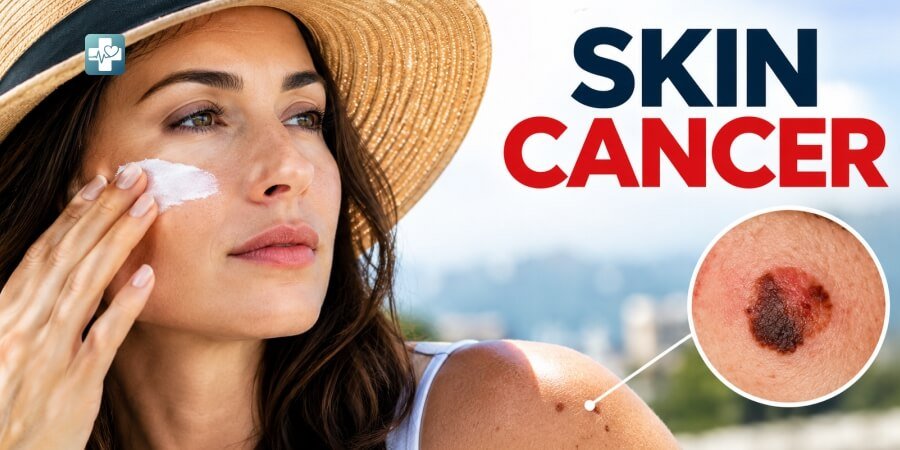
People may go through a large number of videos related to skin-care practices before they eat lunch, which, once again, will be done in the usual way and probably hit on real skin-care issues. So, the video creators offer contradictory pieces of advice: some say that there is no need to put sunscreen before going out to enjoy the natural sunlight; others argue that one can make the sunscreen at home. Also, one can come across messages saying that tanning is a healthy process or that putting on sunscreen is more harmful than being exposed to UV rays. Thus, social media gives people access to a lot of informal tips that are incorrect, and their wrong intentions may lead them to various serious consequences. For instance, one may suffer from skin cancer because of these misleading messages.
There are many causes to be worried about. According to the report of the CDC, skin cancer is the most widespread type of cancer in the USA, with around 6,100,000 people treated for basal cell and squamous cell carcinoma every year, which causes about $8.9 billion annually. Furthermore, this department states that the reason for most incidences of melanoma, which is the most deadliest skin cancer.
The Social Media Sun-Safety Problem
The increase in connections between social networks and skin cancer prevention cannot be overlooked. A research conducted by the American Academy of Dermatology found out that more than 16 million American adults changed or prohibited the use of sunscreen due to the claims they received through the digital platform. While 36% of Generation Z stated that Instagram or TikTok influencers are their main source of information on skin care, only 21% of the population in the US can be considered that way. A study conducted by the American Academy of Dermatology shows that almost half of Americans who took a quiz on sun safety scored a C or even lower, and one third of Gen Z members received a D or F.
These statistics emphasize an important contradiction. People have a lot of knowledge about various health issues, but they do not understand which piece of information should be trusted. Social media platforms encourage certain activity types, namely content that deals with surprising, personal, or controversial ideas.
Why Bad Advice Can Sound So Persuasive
One of the issues related to incorrect knowledge of skin cancer is that people who post information online often make true observations but link them to false conclusions. A person may make the right observation that vitamin D is good for health but make the wrong conclusion that one needs to deliberately expose one’s skin to direct UV light. Another person may make the statement that the ingredients of some sunscreens are to be taken seriously but then claim that avoiding sunscreen is better than using it.
One can see this happening in the case of the homemade sunscreen. In 2026, the systematic review proved that social media keeps feeding people with unverified information about homemade sunscreens while the data collected about those products show that they cannot protect people from UV rays.
Younger Audiences Are Especially Exposed
The consequences for skin cancer prevention may be crucial for the younger generation, since social media has become an integral part of their decision-making processes. According to AAD findings of 2025, almost half of teenagers surveyed confirmed having a sunburn in the past year, and almost one quarter got grade D or F for sun protection techniques. In addition, it mentioned widespread cultural assumptions that promote tanning and might make some young people underestimate the threat of long-term UV radiations.
However, there’s another side of this issue. Social media can be a useful tool in informing the youth about the issue of sunburns, provided that reliable information becomes available in appropriate forms. Thus, according to a study conducted in 2026, awareness of a sun protection campaign launched on Instagram increased during this initiative from 24.1% to 48.7%. The research participants who had been following the campaign were more likely to use the sunscreen dispensers.
Dermatologists Have to Compete for Attention
For those in the medical field, the issue surrounding false information about skin cancer can be traced back to communication issues. A dermatologist could spend decades studying topics like UV exposure and melanoma prevention, while an influencer can record a 30-second video about their experience and get millions of views. While the dermatologist has more expertise than the influencer, the possibility exists that the expert’s knowledge will remain unheard, while the influencer’s attention-grabbing headline will get repeated exposure in subscribers’ feeds.
Another type of problem is representation. Thus, a study from 2024 that analyzed 500 TikTok videos related to sunscreens and skin protection discovered that only 16.6% of the videos were created by dermatologists, while beauty bloggers made up 38.7% of the videos. Patients and consumers made up another 33.7% of people featured in the videos and only 2.8% of the publications addressed the issue of skin of color.
The existing gap gives the chance for medical professionals to give people relevant and meaningful information while simultaneously addressing their concerns. In this case, the audience is more likely to trust information that takes into account their needs because it reflects what they want to learn rather than telling them what not to believe.
Sun Safety Has to Become More Than a Product Recommendation
It is also important for the discussion about skin cancer to evolve past just being about sunscreen, as one of the CDC’s recommendations states. It suggests to use several types of sun protection as well as to stay clear of indoor tanning, while pointing out that people should protect their skin not only during their beach vacations. Sunscreen is not the only way to protect skin from the sun’s harmful rays.
It is worth mentioning that skin cancer misinformation appears when a creator’s confidence is mistaken for medical safety. No matter how certain a creator might sound, how many followers they have or how strongly they believe in their opinion, none of these things attests to their medical knowledge. It is, however, wrong to distrust all skincare conversations that take place online. Instead, it is obese to expect the brands to get an evidence support for their health claims.
Though social media is changing everything in the way people learn about skin cancer, it can also help make a big step in preventing it. Making trustworthy advice as simple to locate, comprehend, and disseminate as the myths that compete with it is the true issue. In the future, skin protection may depend not only on what people put on their bodies but also on what they decide to believe when they open their phones.